
Why Lifting Safety Matters
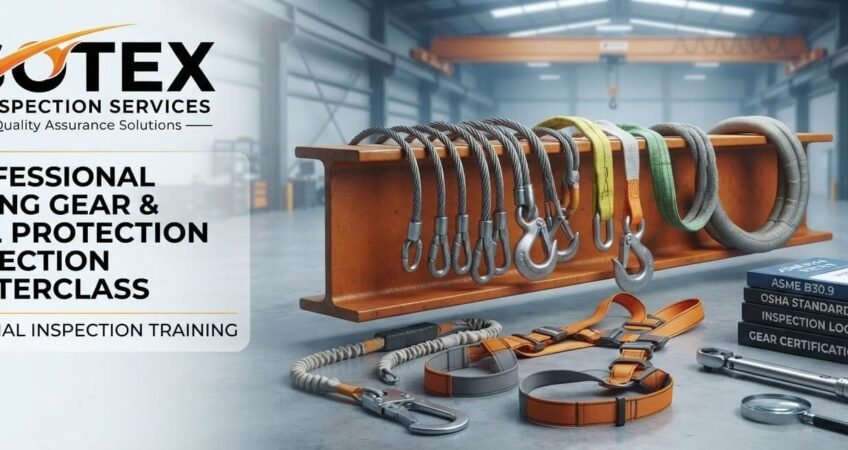
“Welcome to the Professional Lifting Gear & Fall Protection Inspection Masterclass.“
Every industrial facility, construction site, and shipyard relies heavily on safe and efficient material handling. However, a single overlooked flaw in rigging hardware or fall protection equipment can lead to catastrophic dropped loads, structural failures, or fatal workplace accidents.
Our Lifting Gear & Fall Protection Inspection Masterclass is designed for QA/QC professionals, safety inspectors, and rigging engineers who want to master international compliance and field safety. Based on rigorous global standards, including ASME B30.9, ASME B30.26, OSHA 1910.184, and LOLER 1998. This course bridges the gap between theoretical knowledge and practical inspection expertise.
What You Will Learn in This Course
This comprehensive short course covers the end-to-end examination, defect identification, and discard criteria for essential site equipment:
Wire Rope & Synthetic Slings: Spotting broken wires, crushing, and core damage.
Rigging Hardware: Deep-dive checks on shackles, hooks, eye bolts, and turnbuckles.
Lifting Accessories: Safe handling guidelines for plate clamps, master links, and snatch blocks.
Fall Protection: Rigorous safety checks for full-body harnesses, lanyards, and shock absorbers.
Ready to Master Rigging Inspection?
Whether you are preparing for a third-party certification audit or looking to upgrade your field inspection skills, this course gives you the exact tools, terminology, and discard criteria used by certified inspectors worldwide.
Dive into the complete course modules below and start your professional inspection journey today!
MODULE 1: Wire Rope Slings Inspection & Discard Criteria
Introduction to Wire Rope Slings
Wire rope slings are among the most heavily utilized rigging components in industrial lifting operations, construction sites, and heavy engineering projects. Because they handle extreme loads under harsh operating conditions, routine examination and strict adherence to discard criteria are mandatory to prevent catastrophic failures.
As per international standards—specifically ASME B30.9 and OSHA 1910.184—every wire rope sling must be thoroughly inspected by a designated, qualified person prior to each use and at specified intervals.
Key Inspection Parameters & Defect Identification
When performing a field inspection on wire rope slings, an inspector must carefully examine the entire length, including the end attachments, splices, and fittings, looking for specific mechanical flaws:
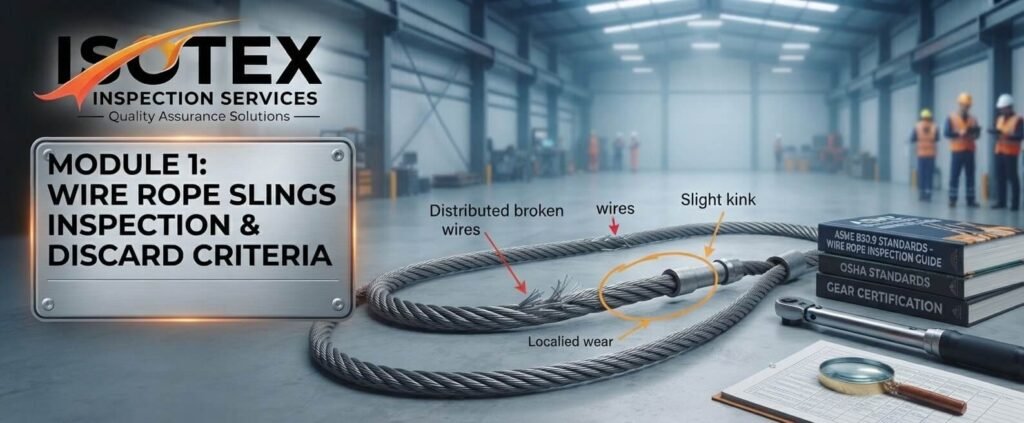
Broken Wires: Identifying distributed broken wires in strand lays and crown breaks near end attachments.
Wear and Abrasion: Checking for localized reduction of rope diameter caused by friction against loads or sheaves.
Corrosion and Pitting: Assessing rust and chemical degradation that weakens the internal and external steel wires.
Deformation: Spotting kinks, birdcaging, crushing, or core protrusion that permanently damages the structural integrity of the rope.
Heat Damage: Looking for discoloration or metallurgical changes resulting from exposure to extreme temperatures or electric arcs.
When to Discard a Wire Rope Sling?
According to ASME B30.9, a wire rope sling must be immediately removed from service and destroyed if any of the following critical discard criteria are met:
Broken Wire Limit: 10 or more randomly distributed broken wires in one rope lay, or 5 or more broken wires in one strand in one rope lay.
Severe Distortion: Kinking, crushing, birdcaging, or any other damage resulting in structural distortion of the rope structure.
Heat Damage: Evidence of heat damage from any source.
End Attachment Defects: Cracks, severe wear, or distortion in hooks, links, or mechanical fittings.
Reduction in Diameter: Any significant reduction of nominal rope diameter below the manufacturer’s recommended threshold due to core failure or abrasion.
Ready to Move to the Next Lifting Gear?
Now that you understand the core inspection protocols and discard criteria for wire rope slings, we can proceed to the next critical component in our masterclass.
MODULE 2: Web & Round Slings Inspection & Discard Criteria
Introduction to Synthetic Slings
Synthetic web slings and round slings offer exceptional flexibility, high strength-to-weight ratios, and surface protection when lifting delicate, polished, or finished loads. However, because they are manufactured from synthetic fibers such as nylon or polyester, they are highly vulnerable to environmental degradation, cuts, chemical exposure, and friction wear.
As per international standards including ASME B30.9 and OSHA 1910.184 routine and rigorous visual examinations are mandatory to ensure these soft slings remain safe for overhead lifting operations.
Key Inspection Parameters & Defect Identification
When inspecting synthetic web and round slings, an inspector must examine the entire length from eye to eye (or the protective cover of round slings), checking for the following critical defects:
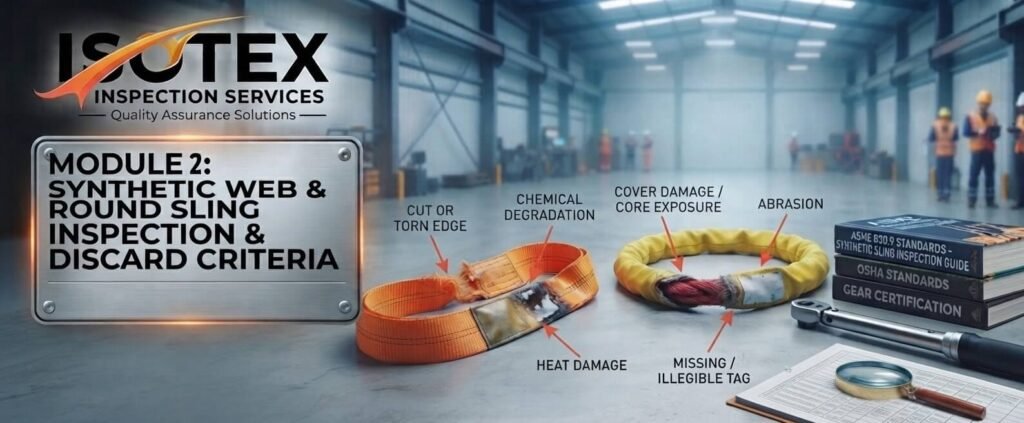
Cuts, Tears, and Slashes: Identifying fiber damage caused by sharp edges of the load or improper rigging.
Chemical or UV Degradation: Checking for stiff, brittle, or bleached areas resulting from acid, alkali, or prolonged ultraviolet light exposure.
Abrasions and Wear: Assessing localized fuzziness or surface wear where the sling rubs against contact points or crane hooks.
Melting and Charring: Spotting heat damage, weld spatter, or friction burns that melt or fuse the synthetic fibers together.
Missing or Illegible Tags: Ensuring the manufacturer’s identification tag (showing capacity, material, and serial number) is fully intact and readable.
When to Discard a Synthetic Sling?
According to ASME B30.9, a synthetic web or round sling must be immediately removed from service and destroyed if any of the following discard criteria are observed:
Acid or Caustic Burns: Evidence of acid, alkali, or chemical damage resulting in fiber weakening or discoloration.
Melting or Charring: Any part of the sling showing heat damage, melting, or weld spatter burns.
Holes, Tears, Cuts, or Snags: Any deep damage that compromises the load-bearing yarn structure of a web sling or breaches the outer protective cover of a round sling (exposing the core yarns).
Broken or Damaged Stitching: Stitches in load-bearing splices that are broken, torn, or unraveled.
Illegible or Missing Capacity Tag: If the rated capacity tag is missing or completely unreadable, rendering the working load limit (WLL) unknown.
Ready to Move to the Next Lifting Gear?
Now that you have mastered the inspection protocols and discard parameters for synthetic slings, we can move forward to examine hard rigging hardware.
MODULE 3: Rigging Hardware (Shackles, Hooks & Eyebolts) Inspection
Introduction to Rigging Hardware
Rigging hardware acts as the vital connecting link between the lifting machine, the slings, and the load. Components such as anchor shackles, chain shackles, hoist hooks, and eyebolts endure immense mechanical stresses, dynamic loading, and multi-directional forces during industrial operations.
Because structural failure in any single piece of hardware can cause dropped loads and fatal accidents, regular and thorough examinations under ASME B30.26 and relevant ASME/OSHA guidelines are compulsory.
Key Inspection Parameters & Defect Identification
When inspecting rigging hardware in the field, a qualified inspector must closely examine each component for mechanical wear, dimensional changes, and material defects:
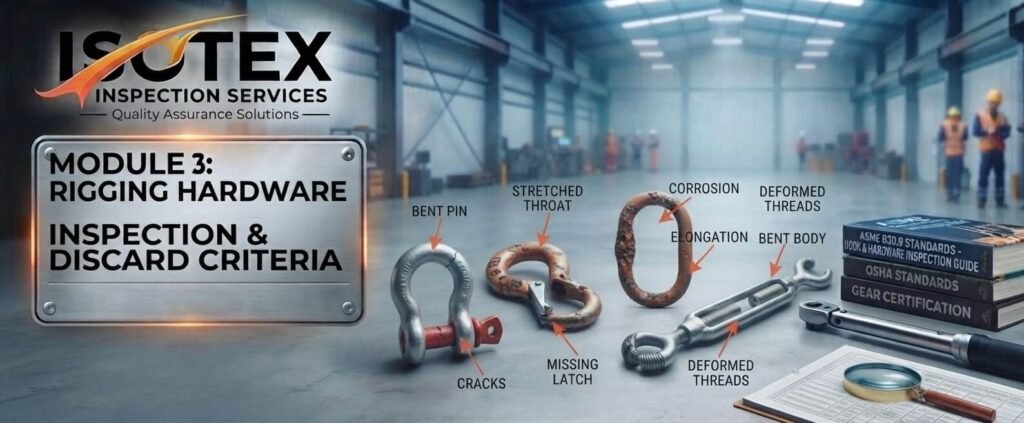
Cracks and Fractures: Inspecting high-stress points, pin holes, and bends for any surface or structural cracking (often verified via MPI or PT if required).
Excessive Wear: Checking for material loss due to friction, particularly on shackle bodies, pin threads, and hook saddle/throat areas.
Deformation and Bending: Identifying bent shackle pins, twisted hook bodies, or stretched throat openings caused by overload or shock loading.
Corrosion and Pitting: Assessing rust, scale, or chemical pitting that reduces the cross-sectional strength of the hardware.
Thread Damage: Checking for stripped, galled, or deformed threads on shackle pins, turnbuckles, and eyebolts.
When to Discard Rigging Hardware?
According to international standards, any piece of rigging hardware displaying the following conditions must be immediately removed from service and destroyed:
Any Visible Cracks or Fractures: Zero tolerance for cracks of any kind in hooks, shackles, or fittings.
Wear Exceeding 10%: Any reduction of dimension (such as wear on a shackle bow or hook throat) exceeding 10% of the original catalog size.
Severe Permanent Deformation: Any bending, twisting, or stretching that exceeds the manufacturer’s allowable tolerances (e.g., an increase in hook throat opening beyond the manufacturer’s discard limit).
Damaged or Missing Pins: Shackle pins that are severely bent, cracked, or replaced with non-approved bolts or improvised pins.
Illegible Markings: Loss of manufacturer’s name, trademark, or rated working load limit (WLL) stamped on the hardware.
Ready to Move to the Next Lifting Gear?
Now that you have learned the critical inspection and discard parameters for rigging hardware, we are ready to move on to the final layer of safety: personal protection during lifting operations.
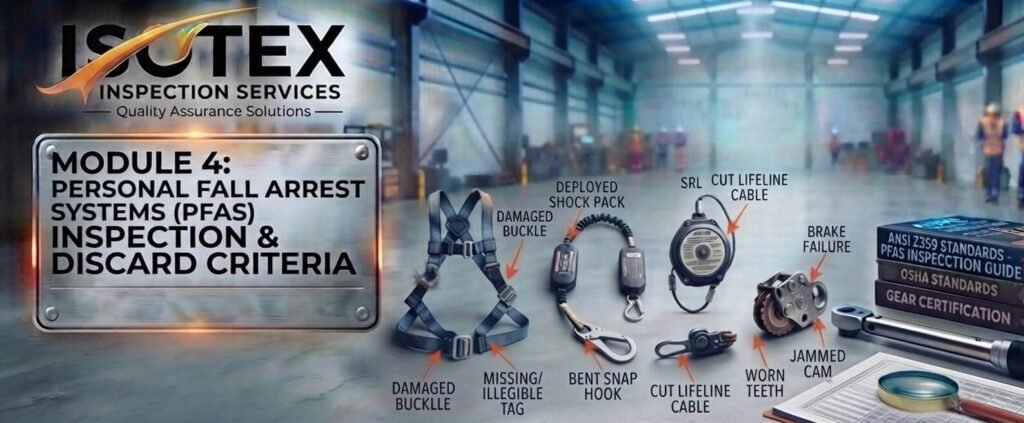
MODULE 4: Fall Protection Equipment Inspection & Discard Criteria
Introduction to Fall Protection Systems
While rigging hardware and slings ensure safe material handling, fall protection equipment is the critical last line of defense protecting workers operating at heights during lifting and construction activities. Equipment such as full-body harnesses, shock-absorbing lanyards, self-retracting lifelines (SRLs), and horizontal wire rope lifelines are subjected to severe environmental conditions and potential impact forces.
As per international safety standards, specifically ANSI Z359 and OSHA 1910.140 / 1926.502. Every component of a personal fall arrest system must undergo rigorous pre-use checks by the user and periodic formal inspections by a competent person.
Key Inspection Parameters & Defect Identification
When inspecting fall protection gear, an inspector must meticulously examine every inch of webbing,
stitching, hardware, and rope components.
Webbing and Rope Damage: Checking for cuts, frayed edges, pulled threads, abrasion, chemical damage, or UV degradation on harnesses and lanyards.
Stitching Failures: Inspecting load-bearing stitch patterns and safety indicators (such as deployed deployment warning threads on shock absorbers) for breaks or pulls.
Hardware Integrity: Examining snap hooks, carabiners, D-rings, and adjustment buckles for cracks, sharp edges, distortion, or corrosion.
Mechanical Functionality: Testing gate mechanisms on hooks and self-retracting lifelines (SRLs) to ensure smooth automatic locking and retraction.
Product Labelling: Verifying that product labels, serial numbers, inspection logs, and manufacturer instructions remain fully legible and attached.
When to Discard Fall Protection Equipment?
According to regulatory standards, any fall protection component exhibiting the following conditions must be immediately taken out of service, marked “DO NOT USE,” and permanently destroyed:
Evidence of Impact Loading: Any harness, lanyard, or lifeline that has been subjected to the forces of arresting a real fall must be removed from service instantly.
Cuts, Burns, or Chemical Damage: Acid burns, melted synthetic fibers from weld spatter, or deep cuts/tears in webbing exceeding standard wear limits.
Broken or Unraveled Stitching: Any broken, pulled, or missing stitches in primary load-bearing web areas or safety packs.
Hardware Malfunctions: Deformed D-rings, cracked snap hooks, or gate mechanisms that fail to close and lock securely.
Missing or Illegible Labels: If the manufacturer’s inspection and rating label is missing or unreadable, making it impossible to verify compliance and capacity.
Masterclass Conclusion
Congratulations! You have successfully completed all four core modules of the Professional Lifting Gear & Fall Protection Inspection Masterclass.
Mastering the Professional Lifting Gear & Fall Protection Inspection Masterclass ensures that your team maintains top-tier industrial rigging inspection protocols across every worksite. By deeply understanding wire rope sling safety, performing meticulous synthetic web sling examination, and strictly adhering to modern fall protection harness standards, industrial facilities can eliminate hazards, achieve total regulatory compliance, and prevent catastrophic failures. Start learning today to elevate your workplace safety and technical inspection expertise.